The most famed and well-regarded collaboration between New German Cinema director Werner Herzog and his frequent leading man, Klaus Kinski, this epic historical drama was legendary for the arduousness of its on-location filming and the convincing zealous obsession employed by Kinski in playing the title role. Exhausted and near to admitting failure in its quest for riches, the 1650-51 expedition of Spanish conquistador Gonzalo Pizarro (Alejandro Repulles) bogs down in the impenetrable jungles of Peru. As a last-ditch effort to locate treasure, Pizarro orders a party to scout ahead for signs of El Dorado, the fabled seven cities of gold. In command are a trio of nobles, Pedro de Ursua (Ruy Guerra), Fernando de Guzman (Peter Berling), and Lope de Aguirre (Kinski). Traveling by river raft, the explorers are besieged by hostile natives, disease, starvation and treacherous waters.
Watching Ingmar Bergman’s 1961 Through a Glass Darkly now, you’re carried back to a golden era that was also an ice age. The year before, Michelangelo Antonioni’s drifting, elliptical masterpiece L’Avventura had been booed at the Cannes Film Festival; three years later, Carl Theodor Dreyer’s Gertrud would receive still worse treatment on its Paris premiere––an episode compared by one observer to “a spontaneous, unexpected lynching.”
Car salesman Phillip Wagner is driving along an asphalted dirt track used by the locals as a short cut to Wolfsburg. He is having an argument on the telephone with his fiancée when, suddenly, he runs over a child. He sees the child’s body in his rear-view mirror, hesitates, brakes, but does not get out.
The first feature film written and directed by Tolga Karaçelik, better known for his award-winning short films such as Rapunzel, Toll Booth tells a story of miscommunication, isolation and desperate alienation via a conflict between a father and his son. Confined to his own world of dreams, introvert, and reticent, Kenan is a toll booth attendant, who lives with his ailing father. Kenan’s drab life stuck in routines between his toll booth and home will change the day a new manager comes for supervision. (~iksv.org)
Michelangelo Antonioni's first narrative feature is a stark, minimal interpersonal drama that would establish many of the themes and techniques that would recur in his work for the rest of his career. Story of a Love Affair centers on the dynamic between Guido and Paola, two old flames re-igniting their passions for one another.
Orson Welles' free-form documentary about fakery focusses on the notorious art forger Elmyr de Hory and Elmyr's biographer, Clifford Irving, who also wrote the celebrated fraudulent Howard Hughes autobiography, then touches on the reclusive Hughes and Welles' own career (which started with a faked resume and a phony Martian invasion). On the way, Welles plays a few tricks of his own on the audience.
Long out-of-circulation and unavailable on home video, Jean-Luc Godard’s 1964 masterpiece Une femme mariée, fragments d’un film tourné en 1964 en noir et blanc [A Married Woman: Fragments of a Film Shot in 1964 in Black and White] has, until now, represented the ostensibly ‘missing’ key work from the first, zeitgeist-defining phase of JLG’s filmography. The feature which bridges the gap between Bande à part and Alphaville, Une femme mariée is, nevertheless, a galaxy, or gallery, unto itself — a lucid, complex, profoundly funny series of portraits, etched with Godardian acids, of the wife that represents either a singular case, or a universal example, of “a”/”the” married woman, and the men in her orbit.
Godard. We all went to Jean-Luc Godard in the 1960s. We stood in the rain outside the Three Penny Cinema, waiting for the next showing of "Weekend." One year the New York Film Festival showed two of his movies, or was it three? One year at the Toronto festival Godard said, "The cinema is not the station. The cinema is the train." Or perhaps it was the other way around. We nodded. We loved his films. As much as we talked about Tarantino after "Pulp Fiction," we talked about Godard in those days. I remember a sentence that became part of my repertory: "His camera rotates 360 degrees, twice, and then stops and moves back in the other direction just a little_to show that it knows what it's doing!"
With Mon Oncle Antoine, actor Jean Duceppe established himself as Canada's principle purveyor of eccentric relatives. Playing the uncle of 15-year-old Jacques Ganon, Duceppe acts as the lad's confidante through the difficult coming-of-age process. The Canadian backwoods and the mining-town milieu of the 1940s are displayed to excellent nostalgic advantage in this retrospective piece from writer/director Claude Jutra (who also plays a supporting role).
Orson Welles called it the best movie he ever made. No, it's not Citizen Kane (1941), it's The Trial (1962), which has finally been released on an essential DVD. Welles always claimed that Kane was the only film over which he had complete control, but The Trial came close. He had control over every aspect except the music, which to my ears, turned out great.
A very, very loose and highly symbolic adaptation of The Tibetan Book of the Dead, Gaspar Noé's Enter the Void unfolds in four major parts. Oscar (Nathaniel Brown) is a young, drug-dealing American in Tokyo with an unusually close relationship to his stripper sister, Linda (Paz de la Huerta), and a taste for the chemical hallucinogen DMT. First, we follow him through an average night, from stoner philosophizing ("DMT only lasts for a few minutes, but it feels like eternity—it's a little like dying would be the ultimate trip") to a drug deal gone horribly wrong.
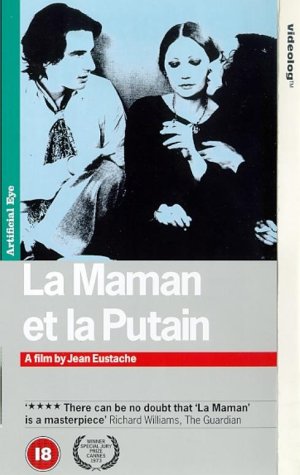
In his 1982 obituary for Jean Eustache, critic Serge Daney wrote that thanks to The Mother and the Whore, people would remember exactly what it was like in Paris for the generation that came in the wake of May 1968. The Mother and the Whore is most certainly a document of its time, as precise in its rendering of the rhythms and textures of Bohemian life as it is possible to imagine. But it's also much more than that. Eustache digs deeply into the emotional complications between the triangle of Alexandre (Jean-Pierre Léaud, in what may be his greatest role), Marie (Bernadette Lafont, the 'mother') and Veronika (Françoise Lebrun, the 'whore').
Released in 1965, Jean-Luc Godard's 'Pierrot Le Fou' was his tenth feature film in only six years, and for many represents a career highpoint.
Loosely based on Lionel White's novel 'Obsession', Godard uses the story (a man fed up with his materialistic life runs off with his child's babysitter and chaos ensues) as a framework to incorporate many elements of his personal philosophies, as well as ideas and techniques already introduced in previous films. The presence of Jean-Paul Belmondo on the run evokes 'A bout de souffle', and the stunning widescreen cinematography recalls 'Le Mepris'.
A grizzled film director sets out with several members of his household (including the fictitious granddaughter of Albert Camus) to stage a Musset play in embattled Sarajevo.
As these modern-day Quixotes proceed on their fool?s quest through the bloody chaos of Bosnia, Godard provides witty, wintry updates of earlier masterpieces, including Weekend (journey of bourgeois buffoons through an apocalyptic, neo-barbarian landscape), Les Carabiniers (absurdist war film with offhand atrocities), and Contempt (contentious filmmaking by the sea, with ranting producer, exasperated actress, and pornographic dialogue).
With its giddily complex noir plot and color-drenched widescreen images, Made in U.S.A was a final burst of exuberance from Jean-Luc Godard’s early sixties barrage of delirious movie-movies. Yet this chaotic crime thriller and acidly funny critique of consumerism—starring Anna Karina as the most brightly dressed private investigator in film history, searching for a former lover who might have been assassinated—also points toward the more political cinema that would come to define Godard.
“As the 1960s drew to a close, European erotica really had its work cut out for it. In particular, Sweden, the country known for crashing American art houses with racy dramas, found itself competing with other countries like France and Italy to produce the latest scandal du jour. Budgets got bigger, acting got better, and plots became richer as directors tried to push the envelope, and no one benefited from this more than director and distributor Radley Metzger. Vibration (Lejonsommar) was released overseas hot on the heels of Metzger's Therese and Isabelle, also starring the fascinating and talented Essy Persson, and it shows the increasing influence of directors like Ingmar Bergman (who, lest we forget, was also promoted at first in the U.S. more for his flashes of skin than his artistic merit).
A wonderful film from my favourite Serbian director. It is a bitter film, almost a tragicomedy, about a person whose sense of morality and justice is at odds with the general coruption surrounding him. A dissillusioned communist, paralysed with fear that his support for Stalin during the clash with the USSR will surface and destroy him is on a spiral downfall to the gutters of the supposedly egalitarian society. Of course, the gutter is populated by a host of characters struggling to survive like rats in a dog-eat-dog (or better rat-eat-rat) society. Alcholics, whores, homosexuals, black marketeers bite against each other like starving rats in a barrel, but there is no way any of them is going to be able to claw out of it....
I can not make an impartial judgement, but, for what is worth, I highly recommend this film.
ECSTASY IN BERLIN, 1926
2004 in b&w and tinted
A film by Maria Beatty
Duration: 45 minutes
Starring: Sonya Sovereign and Paula Rosengarthen
Music by Nick Holmes
THIS DECADENT AND LUMINOUS FILM IS A NEW ACHIEVEMENT IN THE REALM OF EROTICA!
A mix of dreams, nightmares, fears and sexuality, filtered through a mordant Belgian sensibility, "Black Night" envelops rather than illuminates the viewer. First feature by writer-academic Olivier Smolders, whose occasional shorts the past 20 years have been in a similarly Expressionist vein, is perfectly tailored for fantasy festivals and other specialist events but, despite its visual merits, won't travel far beyond Euro arthouse niches.
Jade Warrior director Antti-Jussi Annila crafts this transcendentalist shocker set in 1595, and following two brothers as they descend into a world where there is no such thing as salvation. Protestant Sweden and Orthodox Russia have just reached an uneasy truce. In the wake of their fighting, Finland has become a wasteland. Conquered Finnish brothers Knut and Erik are polar opposites; one is a hardened warrior whose mind has been twisted by the horrors of war, the other is a gentle scientist with no use for fighting.