Pages

Showing posts with label 30's. Show all posts

Mikhail Romm - Pyshka AKA Boule de suif [Silent Version] (1934)

This is the original silent version (no audio, found by agape in rutracker) and has been allowed as alternative version by sigloxx. The other version on the tracker has a soundtrack which was recorded in 1955 (music and voice-over narration) and a few more intertitles. For the background of the production, check the Russian links below (translate them in google). With improved subtitles.
Pyshka - Пышка
Boule de suif (Suet Dumpling or Butterball)

Director: Mikhail Romm
Writers: Mikhail Romm and Guy de Maupassant (story)
Cinematographer: Boris Volchek
Designers: I. Shpinel & P. Beitner

Curtis Bernhardt - Le Tunnel (1933)

The crowning glory of Mac Allan’s engineering career will be the construction of a tunnel beneath the Atlantic Ocean to connect America with Europe.  But first he must find financial backing for the project. After some fierce negotiations, the project is given the go-ahead and work can begin.  Unfortunately for Mac Allan this bold feat of human endeavour will involve a greater sacrifice than he had imagined...

James Whale - The Invisible Man (1933)

A mysterious man, whose head is completely covered in bandages, wants a room. The proprietors of the pub aren't used to making their house an inn during the winter months, but the man insists. They soon come to regret their decision. The man quickly runs out of money, and he has a violent temper besides. Worse still, he seems to be some kind of chemist and has filled his room with messy chemicals, test tubes, beakers and the like.

Aleksandr Andriyevsky - Gibel sensatsii aka Loss of Feeling (1935)

This Russian sci-fi film, an adaptation of the Czech classic novel that gave the world the term "robot," tells the tale of an idealistic inventor who designs strong and intelligent robots to do human work. Unfortunately, the machines are utterly soulless. When factory bosses begin attempting to replace all people with the new robots, the displaced workers revolt

Sergei M. Eisenstein - Aleksandr Nevskiy [+Extras] (1938)

Eisenstein drew on history, Russian folk narratives, and the techniques of Walt Disney to create this broadly painted epic of Russian resilience. This story of Teutonic knights vanquished by Prince Alexander Nevsky’s tactical brilliance resonated deeply with a Soviet Union concerned with the rise of Nazi Germany. Widely imitated—most notably by Laurence Olivier’s Battle of Agincourt re-creation for Henry V —the Battle on the Ice scene remains one of the most famous audio-visual experiments in film history, perfectly blending action with the rousing score of Sergei Prokofiev.

Erle C. Kenton - Island of Lost Souls (1933)

The forgotten horror classic based on the novel "The Island of Dr Moreau" by H.G. Wells.

Charles Laughton stars as the mad scientist experimenting on a remote tropical island, accelerating the evolution of wild animals, and playing God over his half human creatures... Bela Lugosi is almost unrecognizable as their mutant leader, the Sayer of the Law.

Initially banned in many countries and some parts of the United States. British censors claimed the film was against nature (Laughton replied: "So is Mickey Mouse.") and it would not be released in England before 1959. Wells was apparently delighted with the ban. The film does miss most of the finer points of his 1896 fable, and it introduces a new sexual motive: Moreau seeks to mate his creatures with the young couple who chance upon his island...

Tod Browning - Dracula [+Extras] (1931)

The first official Dracula movie was directed by Tod Browning, with a screenplay based on the stage play by Hamilton Deane and John L. Balderston. The title role was played by Bela Lugosi. Also starring in the film were David Manners as Jonathan Harker, Helen Chandler as Mina Murray/Harker and Dwight Frye as Renfield.

Carl Laemmle Jr had originally intended the movie to be a lavish production to rival both The Hunchback of Notre Dame and The Phantom of the Opera, and, like those films, Laemmle insisted it must star Lon Chaney (despite him being under contract at Metro-Goldwyn-Mayer). Tod Browning was then approached to direct this new Universal epic, however, a number of factors would limit Laemmle's plans: Firstly, Chaney (who had been diagnosed with throat cancer in 1928) had sadly succumbed to his terminal illness.

Ernst Lubitsch - The Smiling Lieutenant (1931)

In the years after a rigid Production Code imposed morality on American cinema, occasionally a studio would go begging to the Production Code Administration. The studio would say, "Hey, we have this movie that was made before the Code. Please, please can we rerelease it?" Often the PCA would say no, but sometimes it would say, "OK, sure, but only if you make these cuts."

Leni Riefenstahl - Triumph des Willens aka Triumph of the Will (1935)

A legendary propaganda/documentary of the Third Reich's 1934 Nuremberg Party Rally. Featuring a cast of thousands as well as, of course, Hitler, Himmler, Goebbels, Hess, Goering and other top party officials.
 

Designed by Nazis, for Nazis, and about Nazis. Triumph of the Will was filmed by the German Propaganda Ministry in 1934 and covers the events of the Sixth Nuremburg Party Congress. The original intention was to document the early days of the NSDAP, so as future generations could look back and see how the Third Reich began. In reality, Triump des Willens shows historians how the Nazi state drew in the masses through propaganda and also how Adolf Hitler had a unique and terrifying ability to entice crowds to his beliefs by the very power of his words.

Roy William Neill - Black Moon (1934)

In the 1930s and 1940s, it seems like nothing scared white America like being outnumbered by Negroes. An endless stream of African jungle adventure films came out exploiting that fear, as did a number of voodoo tales -- Black Moon being one of the earliest. Unlike predecessor White Zombie and successor I Walked with a Zombie, Black Moon details a white woman's encounter with voodoo without dragging in those precocious living dead. This well-made but obscure flick takes place on the fictional Caribbean isle of San Christopher, the birthplace of said white woman, Juanita Perez Lane (Dorothy Burgess). After her parents were killed by the ever-restless natives, Juanita was raised by her Uncle Raymond (Arnold Korff) -- that is, until he discovered that her nurse, "that black woman Ruva" (Madame-Sul-Te-Wan), "filled [her] with the sound of the drums and the sight of blood, poisoned [her] with the voodoo". Raymond shipped her away to New York and apparently beat her senseless, as she has now little memory of her childhood hijinx. Now married to Stephen (Jack Holt) with an adorably irritating child, Nancy, Juanita begins to have a strange compulsion to drum... Drum like the wind! She decides to go back to San Christopher to face the source of her neurosis, and Stephen, the ever-concerned husband, sends his secretary Gail (Fay Wray) to protect her.

Raffaello Matarazzo - Treno popolare (1933)

One of the beacon films of the European cinema of the Thirties. Celebrating the sound film as a rebirth of cinema, Treno popolare combines and harmonises, with genius, several characteristics of the cinema of the period. Talking pictures, of which it is too often said that they rendered cinema theatrical, also accentuated and stimulated realism. (...) This realism, born from sound and the possibility to make characters speak in their own langauage and with their true voices, here extends to a unanimist depiction of Italian society, and notably of the petite bourgeoisie of the time, portrayed with great veracity in its daily activity and behaviour.

Vladimir Shnejderov - Dzhulbars (1935)

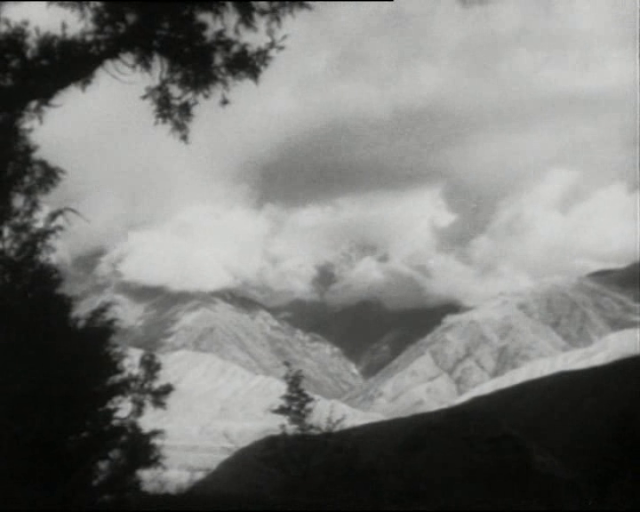
The film tells the story of opposing guards and courageous shepherd Djulbars gang, headed by former baem. Detachment Basmachi attacks on the peace caravan, wandering in the mountain villages, and old-conductor Shaw Murad (Nikolai Cherkasov-Sergeyev) with his granddaughter Pary (Natalia Gitserot) are held captive by the bandits.

The film was shot in the Pamirs, on the outpost in the village of Sufi-Kurgan, 150 km from Osh.

"... Matched to watch episodes of the material on the screen. At a regular display is present is illustrated by Lux - who plays the brave dog Djulbars border. He is, as befits a well-bred dogs, does not respond to himself, which, apparently, takes over another dog, nor horse, nor the actors. But when it appears on the screen each actor Makarenko in costume assistant chief outpost, canine heart can not stand. He learned friend starts quietly whimpering, wagging its tail and otherwise express their feelings in a loud, enthusiastic barking ..."
From the diary of the film's director, VA Shneyderov, 1936

Robert N. Bradbury - Hittin' the Trail (1937)

This was one of the earlier uses of Robert Tansey's favorite plot (only the 3rd time he had trotted it out of the stable, but he got six more films out of it in later years) in which a group of outlaws (wrongly jailed this time) are let out to join up with the good guys against a worse bunch of outlaws. And, not unusual in the B-western genre, most of the production crew wore several hats; director Robert N. Bradbury and supervisor Lindsley Parsons wrote a song for Tommy Bupp, one of the actually good kid actors of the time who proved real quick-like that singing wasn't his strong suit, while Robert Emmett Tansey worked three jobs under three names... Robert Emmett on story and screenplay, Robert Tansey as the production manager and Al Lane as the assistant director. And, for a change, music director Frank Sanucci actually earned a composers' credit as he did write a song, as opposed to the multi-times some source keeps insisting on crediting him as a composer when he was really the musical director serving up canned music.

Vintage Erotica Anno 1930 (2003)

Artists have explored the erotic image since the beginning of time. On the walls of caves, on Hindu Temples, in ancient scrolls, humans have celebrated the sexual act. Cinema is no stranger to eroticism, but there is a mistaken belief that erotic cinema is an invention of the past fifty years. In order to dispel this myth we present this archive of erotic images captured by our "grandfathers camera."

Alessandro Blasetti - 1860 [+Extras] (1933)

Alessandro Blasetti - 1860 [+Extras] (1933)


Alessandro Blasetti directed this historical drama focusing on the Battle of Calatafimi. In May, 1860, the citizens of Sicily rebelled and defeated the troops sent by the King of Naples to put them down. Blasetti uses an amateur cast speaking in regional dialects, which gives his film an authenticity in sharp contrast to most of the pompous epics being churned out at the time.

The story concentrates on the rebels themselves, including a rebel's wife and the young shepherd (Giuseppe Gulino) who travels to Genoa to enlist the aid of Garibaldi. The film's style (and its focus on peasants) is almost a precursor to neo-realism, and presents a very human portrait of the forces behind battlefield spectacle. (Xploited Cinema)

Bernard B. Ray - In Old Montana (1939)

The Colonel sends Fred Dawson and Doc Flanders to investigate a cattleman sheepman war. Posing as a two man medicine show...The war between cattle ranchers and sheepmen once again took center stage in this low-budget Western starring former opera baritone Fred Scott. Scott played Army Lieutenant Fred Dawson who upon learning that his father has been wounded heads for home disguised as a medicine show performer.

René Clair - Sous les toits de Paris AKA Under the Roofs of Paris [+Extras] (1930)

In René Clair’s irrepressibly romantic portrait of the crowded tenements of Paris, a street singer and a gangster vie for the love of a beautiful young woman. This witty exploration of love and human foibles, told primarily through song, captures the flamboyant atmosphere of the city with sophisticated visuals and groundbreaking use of the new technology of movie sound. An international sensation upon its release, Under the Roofs of Paris is an exhilarating celebration of filmmaking and one of France’s most beloved cinematic exports.

Noburo Ofuji - The Roots of Japanese Anime until the End of WWII (1930-1942)

A rare glimpse of early Japanese sound anime and prewar Japanese culture, The Roots of Japanese Anime features the masterworks of such pioneers of Japanese animation as Noburo Ofuji, Yasuji Murata, and Kenzo Masaoka, in addition to Mitsuyo Seo’s Momotaro’s Sea Eagle, the notorious war cartoon billed as Japan’s first feature anime. These movies represent the brilliance and variety of anime, ranging from beautiful Japanese paper animation to powerful multiplane cel cartoons. They also evoke the fascinating complexity of Japan, a nation that is then both marching towards war, enlisting kids in militarist nationalism, yet also delighting in a mixture of modern popular culture, ancient folk tales, irreverent comedy, and the everyday life of prewar Japanese children.

William A. O'Connor - The Pace That Kills AKA Cocaine Fiends (1935)


Often compared to Reefer Madness, this low-budget exploitation melodrama features Lois January as Jane Bradford, a small-town coffee-shop waitress falling in love with smooth-talking city hoodlum Nick Brogan (Noel Madison), who gets her hooked on cocaine. While Jane goes from pretty ingénue to a hardened nightclub habitue known as Lil, her brother Eddie (Dean Benton), a waiter in a drive-in restaurant, is persuaded by co-worker Fanny (Sheila Manners) to enjoy a night on the town. They both become addicts and Fanny is reduced to walking the streets for money. Pregnant and rejected by the hopped-up Eddie, she finally kills herself. Nick, meanwhile, attempts to seduce Dorothy Farley (Lois Lindsay), a bleach-blonde debutante, but the girl is saved in the nick of time by Jane/Lil, who shoots and kills their tormentor. The police arrive to arrest not only Jane but also the mysterious Mr. Big, who turns out to be Dorothy's father (Frank Shannon). Cocaine Fiends also features well-known character actress Fay Holden ("Hasn't he told you yet? Those headache powders are dope!"), who hides behind her original stage moniker of Gaby Fay, and a full-length floor show that includes gawky singer Nona Lee performing "All I Want Is You." The film was a remake of Willis Kent's silent The Pace That Kills (1928), footage from which is used throughout.
Download
http://ul.to/pmg33roz/The_Cocaine_Fiends.part1.rar
http://ul.to/9nfakqfp/The_Cocaine_Fiends.part2.rar

Lew Landers - Crashing Hollywood (1938)


What happened to Lee Tracy after his banishment from MGM? After bouncing around from one studio to another, for the balance of the '30s he landed at RKO making B pictures such as this, where he plays a screenwriter who gets fed information on a criminal gang by a just-released crook and his wife. The breathtaking accuracy of the information gets Tracy both accolades and trouble, especially from perennial nasty gangster Bradley Page. 


Download
http://www.filesonic.com/file/165330501/Crashing_Hollywood_(1938).avi