
Showing posts with label Japan. Show all posts
Showing posts with label Japan. Show all posts
Go Shibata - NN-891102 (1999)

Kon Ichikawa - Nobi AKA Fires On The Plain [+Extras] (1959)

An agonizing portrait of desperate Japanese soldiers stranded in a strange land during World War II, Kon Ichikawa’s Fires on the Plain (Nobi) is a compelling descent into psychological and physical oblivion. Denied hospital treatment for tuberculosis and cast off into the unknown, Private Tamura treks across an unfamiliar Philippine landscape, encountering an increasingly debased cross section of Imperial Army soldiers, who eventually give in to the most terrifying craving of all. Grisly yet poetic, Fires on the Plain is one of the most powerful works from one of Japanese cinema’s most versatile filmmakers.
Masaki Kobayashi - Kwaidan aka Ghost Stories [Uncut] (1964)

Nobuo Nakagawa - Jigoku AKA Hell [+Extras] (1960)

Yasushi Sasaki - Ying chun hua aka Winter Jasmine (1942)

Kô Nakahira - Kurutta Kajitsu AKA Crazed Fruit [+Extras] (1956)

Shohei Imamura - Jinruigaku nyumon: Erogotoshitachi yori AKA The Pornographers (1966)

When not staging stag films in garages and secluded fields, Subu lives with the unhinged Haru (Sumiko Sakamoto), her Oedipal, high-minded son Koichi (Masaomi Kondo), and her impudent teenage daughter Keiko (Keiko Sagawa). Though he lusts after Keiko, the girl -- all too aware of her sexual power over men -- rebuffs his advances in an increasingly cruel manner, leaving Subu to channel his frustrations into the plots of his movies.
Tai Kato - Kaidan Oiwa no borei AKA Ghost of Oiwa (1961)

Satoshi Isaka - Focus (1996)

Through the lens we follow the exploits of a three-person news crew (a reporter, a cameraman and their young woman assistant) on a human interest assignment. From the word go, it's clear to the viewer that their subject is a loser; a timid young man with only one passion in life - listening in on radio and telephone conversations. It is this image the news crew hope to exploit. By juxtaposing shots that show him at his most clumsy and umcomfortable with scenes in the only environment (his hobby) where he is totally at ease, they show this man as a pathetic nerd to which the viewers, and the crew themselves - who clearly have an internal hierarchy that weighs heavy on the shoulders of the young woman, can feel superior.
But the point of this film seems to be that people have many faces. First impressions and the assumptions derived from them are often shallow and false. A monster can dress like a man, but it is still a monster. And vice versa.
Noburo Ofuji - The Roots of Japanese Anime until the End of WWII (1930-1942)

Takashi Miike - Tengoku kara kita otoko-tachi AKA The Guys from Paradise (2000)

Shozin Fukui - Onne (2006)

Even for hardcore fans of Japanese underground movies, the name Shozin Fukui might not immediately ring a bell. This might have something to do with the fact that following the 1996 release of his claustrophobic, ultra-violent, high-speed brain-driller Rubber's Lover, Fukui dropped out of sight for more than 10 years (Midnight Eye). His directorial style is often compared to that of Shinya Tsukamoto - as assistant director Fukui worked with Shinya Tsukamoto on Tetsuo (as well as with Sogo Ishii on Master of Shiatsu (1989). But many fans consider Fukui's aesthetic to be sufficiently divergent from Tsukamoto's for his films to stand on their own, even considering the extremely deep similarities. Fukui' two extremely strange DV-shot cyberpunk horror films in the 90s, 964 Pinocchio in 1991 and Rubber’s Lover are considered important, core films of the Japanese cyberpunk genre. Now he is back with a vengeance - not only have his old films been released on DVD in both the U.S. and Japan, but there's also his new all-out psycho-attack. 10 years later he has released three more movies since then - Onne, Den-Sen, and The Hiding. These three are almost completely unknown outside of Japan (Wiki).
Akira Hirose - Oppai Chanbara AKA Chanbara Striptease (2008)





Download
http://ul.to/eff0t29d/Chanbara.Striptease.2008.DVDRip.AC3_2ch.x264-SGCG.part1.rar
http://ul.to/y2wrhghy/Chanbara.Striptease.2008.DVDRip.AC3_2ch.x264-SGCG.part2.rar
http://ul.to/btcad47i/Chanbara.Striptease.2008.DVDRip.AC3_2ch.x264-SGCG.part3.rar
http://ul.to/jn2tar28/Chanbara.Striptease.2008.DVDRip.AC3_2ch.x264-SGCG.part4.rar
Sadao Nakajima - Poruno no joô: Nippon sex ryokô aka The Pornstar Travels Around Japan (1973)


Ingrid Jacobsen (Christina Lindberg), on arriving in Japan, acquaints a Japanese man at the airport who looks like a sap. He takes her to his apartment where he brutally rapes her and keeps her hostage and bound in chains. Ingrid's alluring beauty eventually enchants the rapist and he is soon consulting his 'How to Stimulate a Woman' sex book in an effort to please her... Of course, our girl exploits this weakness and manages to escape. She then finds her way to a nightclub and to cut a long story short is ganged-banged by some odd-looking characters. Ingrid is not having a lot of luck is she, poor girl! The Japanese man (who seems to have fallen in love with her), finds her walking the streets barefooted and in a terrible state. So he takes her back to his place and tries his best to bring her out of her depressive state of mind but with no avail. He eventually orders her to go but it seems Ingrid has developed a 'Stockholm Syndrome' and refuses to leave. They then live together quite happily until some gangsters arrive to shatter their domestic bliss...
Size 700MB
Language Japanese and some swedish
Subtitles included: English srt included
http://www.filesonic.com/file/1175199554/JOURNEY_TO_JAPAN_AVI.part1.rar
http://www.filesonic.com/file/1175199634/JOURNEY_TO_JAPAN_AVI.part2.rar
http://www.filesonic.com/file/1175249104/JOURNEY_TO_JAPAN_AVI.part3.rar
Masahito Segawa - Oniroku Dan: Bikyoshi jigokuzeme AKA Beautiful Teacher in Torture Hell (1985)


Download
http://ul.to/77us3eyo/Beautiful_Teacher_in_Torture_Hell_(1985).part1.rar
http://ul.to/716ds7qj/Beautiful_Teacher_in_Torture_Hell_(1985).part2.rar
http://ul.to/h23auvpu/Beautiful_Teacher_in_Torture_Hell_(1985).part3.rar
http://ul.to/qwzt1utq/Beautiful_Teacher_in_Torture_Hell_(1985).part4.rar
http://ul.to/wun1e0wy/Beautiful_Teacher_in_Torture_Hell_(1985).part5.rar
http://ul.to/jwn6mho2/Beautiful_Teacher_in_Torture_Hell_(1985).part6.rar
Hirokazu Koreeda - Dare mo shiranai AKA Nobody Knows (2004)


EXEC Yutaka Shigenobu
PROD Hirokazu Kore-eda
SCR Hirokazu Kore-eda
DP Yutaka Yamasaki
CAST Yûya Yagira, Ayu Kitaura, Hiei Kimura, Momoko Shimiza, Ryo Kase
ED Hirokazu Kore-eda
PROD DES Toshihiro Isomi, Keiko Mitsumatsu
MUSIC Titi Matsumura, Gonzalez Mikami
SOUND Yutaka Tsurumaki
Cannes (In Competition): Best Actor, Toronto
Four seasons in the life of an orphaned family: such is the topic of Nobody Knows, the new film by Kore-eda Hirokazu, who was already noticed in Cannes in 2001 with Distance, which was presented in the section "Certain Regard". The interior universe of four children left to themselves after their mother abandons them. A film about the difficulties of childhood, drawn from a news story.Review
Four seasons in the life of an orphaned family: such is the topic of Nobody Knows, the new film by Kore-eda Hirokazu, who was already noticed in Cannes in 2001 with Distance, which was presented in the section "Certain Regard". The interior universe of four children left to themselves after their mother abandons them. A film about the difficulties of childhood, drawn from a news story.
Download
http://ul.to/gvbqa6lt/Nobody_Knows_(2004)_Hirokazu_Koreeda.part1.rar
http://ul.to/nsbbtfhl/Nobody_Knows_(2004)_Hirokazu_Koreeda.part2.rar
http://ul.to/fiimlotv/Nobody_Knows_(2004)_Hirokazu_Koreeda.part3.rar
Teruo Ishii - Tokugawa irezumi-shi: Seme jigoku aka Inferno of torture (1969)

PROD Shigeru Okada
DP Motoya Washyo
CAST Mieko Fujimoto, Reiichi Hatanaka, Yuki Kagawa, Kamiko Katayama, Asao Koike, Miki Obana, Masumi Tachibana, Haruo Tanaka, Teruo Yoshida
MUSIC Masao Yagi
In Nineteenth Century Japan, various women are forced into prostitution in a particular brothel. There, they are raped, tortured, and abused, and the body of each is covered with elaborate tattoos. The artists creating these, meanwhile, participate in a competition to display their skills, which is to be judged by the Shogun. Unfortunately, rivalries amongst these men, together with the greed and ambitions of the owners of the brothel, lead to murders, attempts to sell women into sexual slavery, and other crimes besides these. —movierapture
Kaneto Shindô - Onibaba AKA Devil Woman (1964)




SCR Kaneto Shindo
DP Kiyomi Kuroda
CAST Nobuko Otowa, Jitsuko Yoshimura, Kei Satô, Jukichi Uno, Taiji Tonoyama
ED Toshio Enoki
MUSIC Hikaru Hayashi
SOUND Tetsuya Ohashi
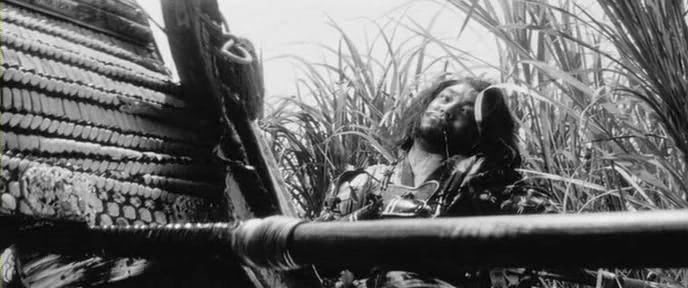
A landmark in fantasy cinema, this lyrical ghost story is set in medieval Japan amid a bloody conflict between rival fiefdoms. While the warrior Kichi's impoverished wife (Jitsuko Yoshimura) and mother (Nobuko Otowa) wait for his return from battle, they maintain a humble existence by luring lost soldiers into the surrounding fields of tall grass and murdering them in order to sell their armor and weapons for food; the bodies are then disposed of in a deep cavern. After learning that her son has been killed in battle, Otowa begins to concoct a scheme to frighten her daughter-in-law into staying at home with her indefinitely. After killing a soldier clad in a hideous demon mask -- which hides his grotesque, scarred face -- the mother dons the mask and succeeds in frightening Yoshimura away from her new lover's house. To her own horror, the mother quickly discovers that the mask is now securely stuck to her face, and her attempts to remove it culminate in the greatest horror of all. Fraught with sexual tension, nefarious schemes, and Freudian symbolism, this compelling masterpiece, by turns hypnotically beautiful and shockingly brutal, represents the finest in horror filmmaking, driven by powerful imagery and aided by sumptuous black-and-white photography.
Download
http://ul.to/848409li/Onibaba_(1964)_Kaneto_Shindo.part1.rar
http://ul.to/5r6qx1bt/Onibaba_(1964)_Kaneto_Shindo.part2.rar
http://ul.to/vp0pfq9l/Onibaba_(1964)_Kaneto_Shindo.part3.rar
http://ul.to/c37tfhav/Onibaba_(1964)_Kaneto_Shindo.part4.rar
Hirokazu Koreeda - Aruitemo aruitemo aka Still Walking (2008)


DIR Hirokazu Kore-eda
PROD Yoshihiro Kato, Satoshi Kono, Hijiri Taguchi, Masahiro Yasuda
SCR Hirokazu Kore-eda
DP Yutaka Yamasaki
CAST You, Hiroshi Abe, Yoshio Harada, Kazuya Takahashi, Shohei Tanaka, Kirin Kiki, Yoshio Tarada
ED Hirokazu Kore-eda
SOUND Shuji Ohtake, Yutaka Tsurumaki
San Francisco (World Cinema), Tribeca (Spotlight), London (World Cinema), São Paulo, San Sebastian (Official Selection), Rotterdam (Spectrum)
Kore-eda’s great new film is what the Japanese call a “home drama”. It chronicles a 24-hour reunion of the Yokoyama family; the two adult children and their families are visiting their elderly parents to mark the fifteenth anniversary of the death of their elder brother, who died rescuing a drowning boy. There are no ‘dramatic’ incidents and the tone is generally light and humorous. But during the day and night we see all that unites and divides this particular family – and makes it just like any other.
The stern patriarch, a retired physician, still mourns his favourite son and intended heir, and doesn’t hide his disapproval of his surviving son and daughter. The mother lets slip the odd remark which betrays the frustrations and disappointments of her marriage; it’s her favourite 1960s pop song which gives the film its title. The central character is the younger son Ryota, a forty-something picture restorer who has only just got married, an adult who has never quite grown up or felt at home in the family. In its unassertive way, this feels as piercingly true as some of the great “home dramas” of the past – such as Ozu’s. —London Film Festival
Download [password: cinefilz.com]
Download [password: cinefilz.com]
Subscribe to:
Posts (Atom)